Master's Thesis · Nuclear structure theory
Four Phonon Anharmonicity and Angular Momentum Effects in Even-Even Spherical Nuclei
Aous Ahmad Abdo · with V. Zelevinsky
Spherical even-even nuclei vibrate in quantized surface ripples — quadrupole phonons. In the harmonic approximation their spectrum is a perfectly even ladder. This thesis treats the anharmonic corrections up to four phonons and solves the resulting Hamiltonian analytically, showing exactly how the degenerate multiplets split and shift.
The idea
Real nuclear vibrations interact. Writing the quartic phonon interaction in terms of the intermediate angular momenta of phonon pairs, and exploiting a hidden rotational symmetry in five-dimensional phonon space, the model becomes exactly solvable through a canonical transformation of the boson-pair operators.
The result
A closed-form energy spectrum. The ground quasi-rotational band takes the compact form
In the harmonic limit λ → 0 the spectrum is exactly equidistant, ; as the anharmonicity λ grows, the multiplets split and the level structure reorganizes — the effect made interactive in Chapter I.
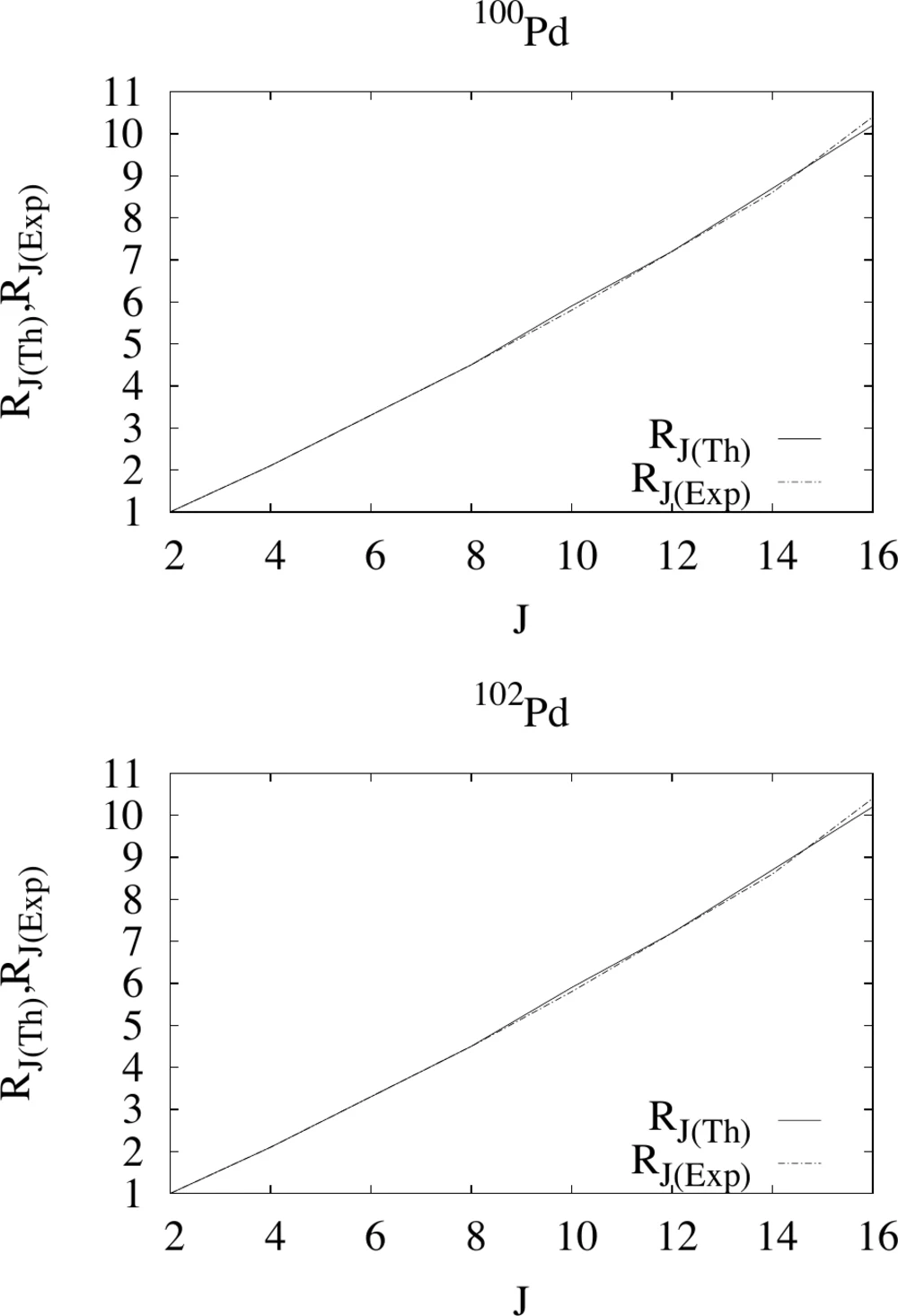
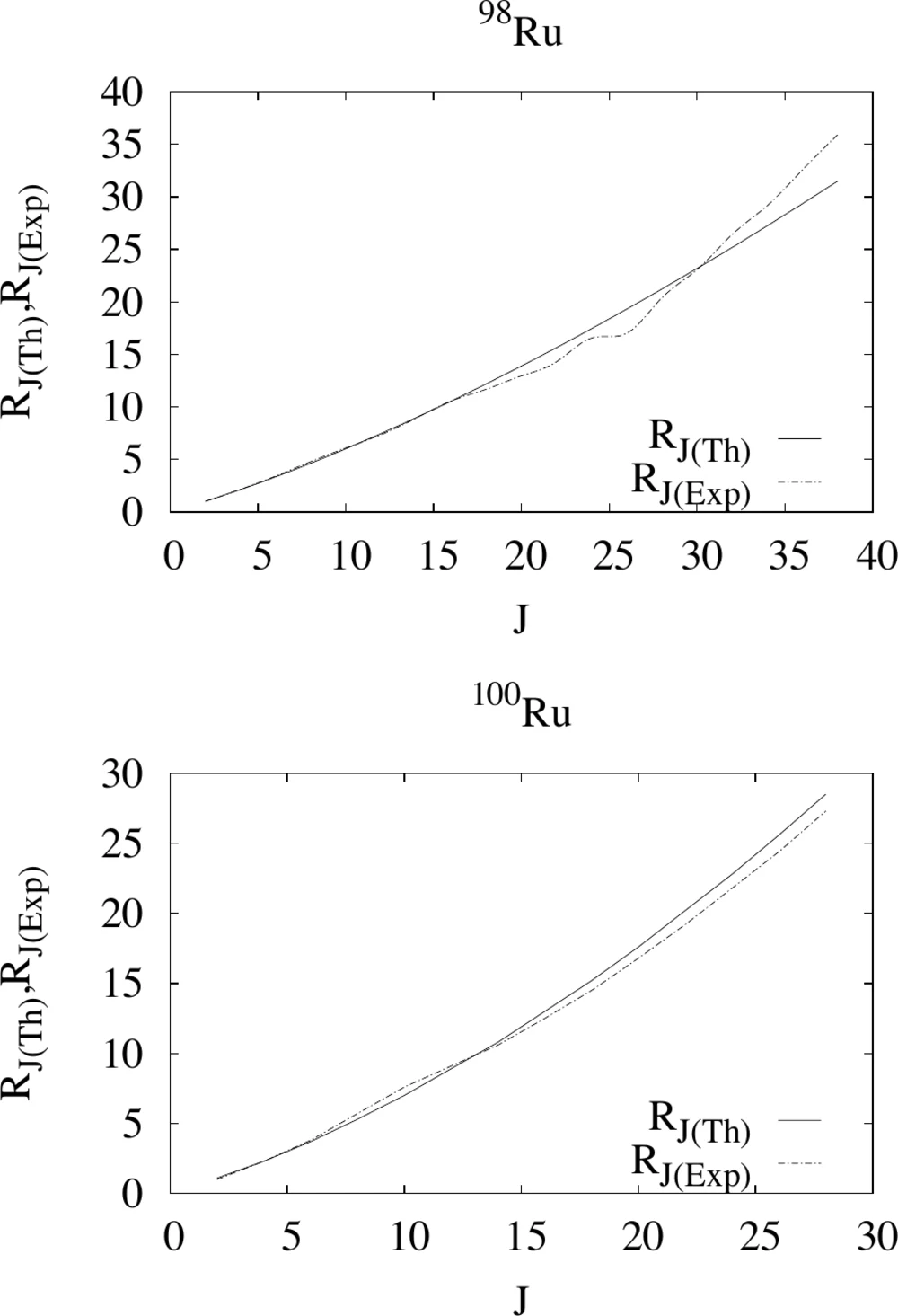
Tested against 42 nuclei
The model is not just formal. The thesis carries it through to real nuclear data, comparing the predicted level-energy ratios RJ against measured values for 42 even-even nuclei across six isotope chains — Se, Kr, Mo, Ru, Pd, Cd — over the full range of angular momentum J. Twenty-two pages of the thesis are these comparisons; two are shown here.