Aous Ahmad Abdo / Astrophysicist
From the Nucleus
to the Cosmos
Two theses and a career spent chasing energy across the scales of the universe — from phonons inside the nucleus to TeV gamma rays from the Galactic plane.
The arc
One story, across the scales of the universe.
Aous Abdo’s research runs from the smallest structures physics can resolve to some of the largest engines in the sky — the same curiosity, pointed thirty-six orders of magnitude apart.
Chapter I · The Master's
Inside the nucleus
Even-even spherical nuclei are not still. Their surfaces ripple, and those ripples come in quanta called quadrupole phonons — the nucleus's own vibrations.
In the simplest picture the vibrations are harmonic: one phonon, two phonons, three, in a perfectly even ladder. Reality is anharmonic — phonons feel each other, and the evenly-spaced multiplets split apart. Aous Abdo's Master's work, with Vladimir Zelevinsky, solved a four-phonon anharmonic Hamiltonian analytically, deriving exactly how that splitting unfolds — then tested it against measured spectra for 42 even-even nuclei across six isotope chains.
Drag the slider from the harmonic limit and watch the degenerate rungs break into the real spectrum.
Each rung is a nuclear state, grouped by phonon number N and labelled by angular momentum L+. At λ = 0 the multiplets are degenerate and evenly spaced (the harmonic vibrator). Turn up λ and the four-phonon anharmonicity splits them apart.
Go deeper — the physics, in full
Writing the quadrupole phonon operators as coordinate and momentum combinations, the Hamiltonian splits into harmonic and quartic parts:
Because H⁽⁴⁾ carries a hidden rotational symmetry in five dimensions, the spectrum can be diagonalized in closed form. The ground quasi-rotational band is
In the harmonic limit λ → 0 this collapses to the equidistant vibrator spectrum ; turning on λ is exactly the splitting the diagram above animates.
Chapter II · The PhD
Catching gamma rays
TeV gamma rays are the most energetic light in the universe — forged by pulsar wind nebulae, supernova remnants, and the violent hearts of star-forming regions. But they are rare. For every gamma ray reaching the atmosphere, thousands of ordinary cosmic-ray protons pour in too, and their showers look almost the same.
Milagro was a pond — a reservoir of water watching the whole overhead sky through the faint blue Cherenkov light of particle showers. Its great strength was seeing everything at once; its weakness was telling gamma from hadron. Abdo built a new discriminator — the A₄ variable — that reads the compactness of each shower's footprint, and paired it with a weighting analysis. The gain was enough to make Milagro's first discoveries.
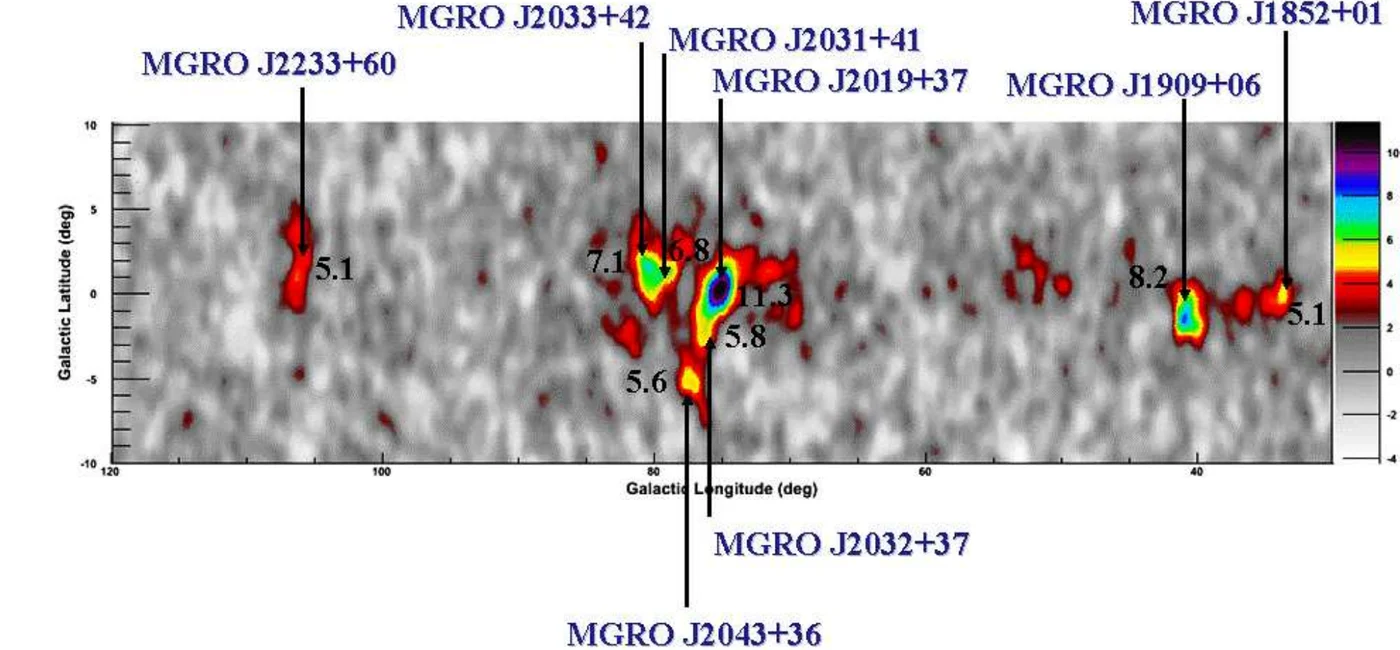
Toggle A₄ below to watch the hadronic haze lift and the sources emerge. Drag to pan the Galactic plane; click a source for its story.
Drag to pan the Galactic plane · click a source
Select a source to read its story.
Go deeper — the physics, in full
Milagro sampled extensive air showers with a two-layer array of photomultipliers under water. Hadronic showers are patchy — they deposit isolated clumps of energy from penetrating muons and hadrons far from the core — while gamma-ray showers are smooth. The A₄ parameter quantifies that patchiness (the largest energy deposit outside a cut radius from the core), giving a gamma/hadron separation that, combined with an energy-dependent optimal weighting of events, sharply increased Milagro's sensitivity to faint, extended sources like the diffuse Cygnus emission.
The payoff: four localized TeV sources (three in Cygnus, one toward the inner Galaxy) plus diffuse emission from Cygnus whose ~12 TeV flux exceeds conventional cosmic-ray models — evidence for hard-spectrum sources hidden in the region.
Chapter III · The career
The Fermi era
The gamma-ray craft Abdo developed at Milagro carried straight into space. As the Fermi Large Area Telescope opened the GeV sky in 2009, he contributed to its early science program — including lead authorship on the instrument paper and major catalogs of gamma-ray sources, pulsars, and active galaxies.
The published record spans 108 papers and 24,938 citations. Each bubble below is a paper, placed by year and citation count. Watch 2009 ignite.
View the leading publication data
- 4,406 citations · 2009 The Large Area Telescope on the Fermi Gamma-ray Space Telescope Mission
- 1,146 citations · 2009 Measurement of the Cosmic Ray e+ plus e- spectrum from 20 GeV to 1 TeV with the Fermi Large Area Telescope
- 1,037 citations · 2010 Fermi Large Area Telescope First Source Catalog
- 962 citations · 2010 The Spectral Energy Distribution of Fermi bright blazars
- 878 citations · 2013 The Second Fermi Large Area Telescope Catalog of Gamma-ray Pulsars
- 612 citations · 2010 The Spectrum of the Isotropic Diffuse Gamma-Ray Emission Derived From First-Year Fermi Large Area Telescope Data
- 608 citations · 2009 Fermi Observations of High-Energy Gamma-Ray Emission from GRB 080916C
- 539 citations · 2009 Fermi Large Area Telescope Bright Gamma-ray Source List
Go deeper — the physics, in full
Most-cited works:
- 4,406The Large Area Telescope on the Fermi Gamma-ray Space Telescope Mission2009
- 1,146Measurement of the Cosmic Ray e+ plus e- spectrum from 20 GeV to 1 TeV with the Fermi Large Area Telescope2009
- 1,037Fermi Large Area Telescope First Source Catalog2010
- 962The Spectral Energy Distribution of Fermi bright blazars2010
- 878The Second Fermi Large Area Telescope Catalog of Gamma-ray Pulsars2013
Signature discovery · Fermi-LAT, 2011
A pulsar's fatal attraction
Every 3.4 years, the pulsar PSR B1259−63 — spinning nearly 48 times a second — comes screaming in toward the massive Be star LS 2883 on an orbit so eccentric (e = 0.87) it nearly grazes the star. Twice near each close pass it plows through the disk of gas the star sheds from its equator, and the collision lights up across the spectrum.
In 2011, Fermi-LAT caught it flaring in GeV gamma rays for the first time — a discovery Aous Abdo led. Press play to run the orbit, or drag the slider to periastron and watch the flare ignite.
- Pulsar
- PSR B1259−63 · 47.8 ms radio pulsar
- Companion
- LS 2883 · O9.5Ve Be star, ~31 M☉
- Orbital period
- 1236.7 days (≈3.4 years)
- Eccentricity
- e = 0.87 (extreme)
- Periastron gap
- ~0.67 AU
- Fermi flare
- GeV, tens of days after periastron
Why it flares: near periastron the pulsar punches through the Be star's disk on the way in and again on the way out — two shocks per passage, matching the twin peaks seen in X-rays and TeV.
Read the originals