PhD Dissertation · Michigan State University · 2007
Discovery of Localized TeV Gamma-Ray Sources and Diffuse Emission from the Galactic Plane with Milagro
Aous Ahmad Abdo · Department of Physics & Astronomy
Very-high-energy gamma rays probe the most powerful objects in the universe — active galactic nuclei, supernova remnants, pulsar wind nebulae. This dissertation introduces a new background-rejection technique for the Milagro water-Cherenkov detector: the A₄ gamma-hadron separation variable, coupled with an event weighting analysis. Together they sharpened Milagro enough to make its first discoveries.
What it found
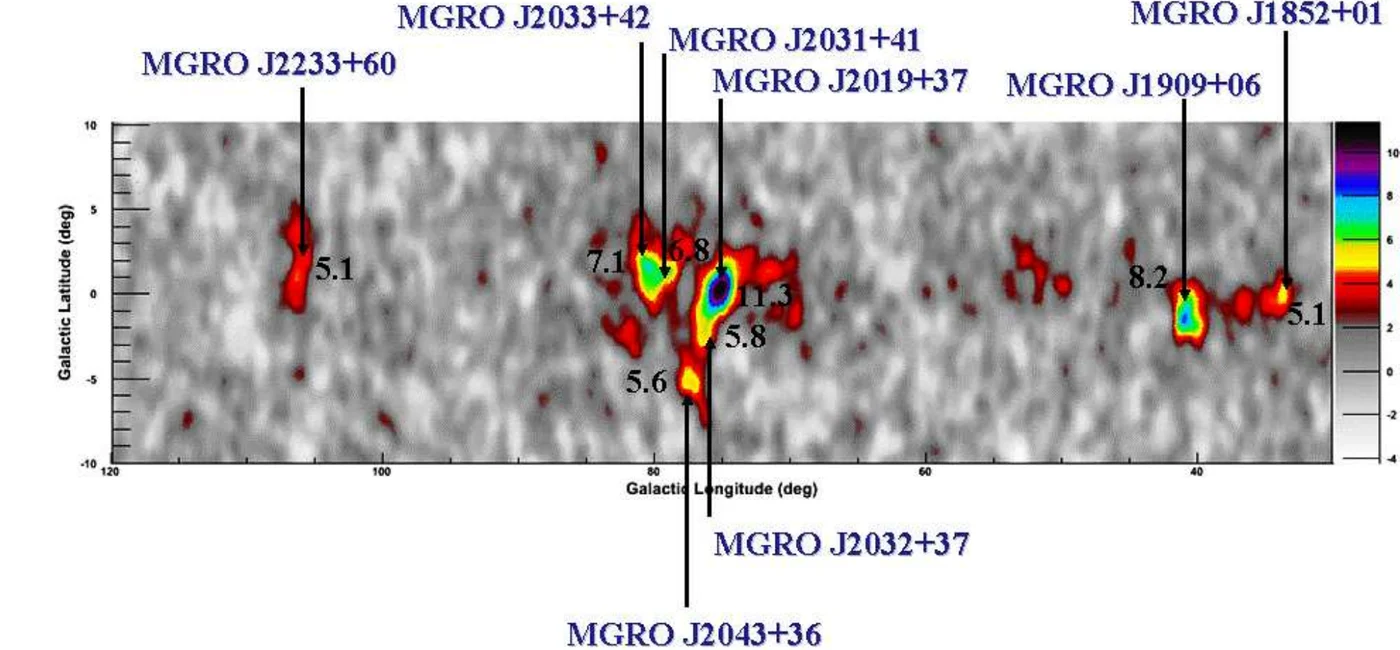
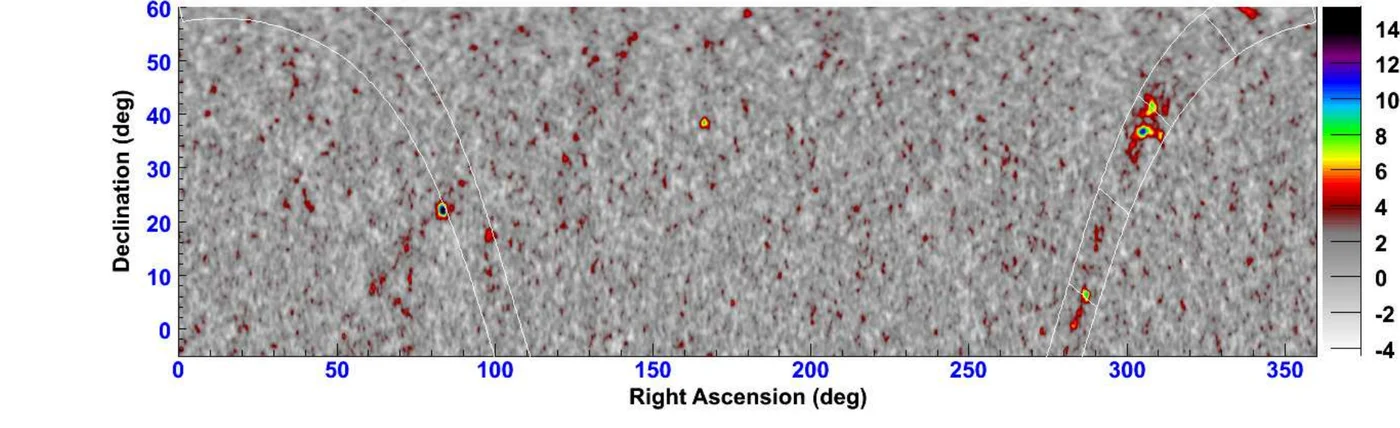
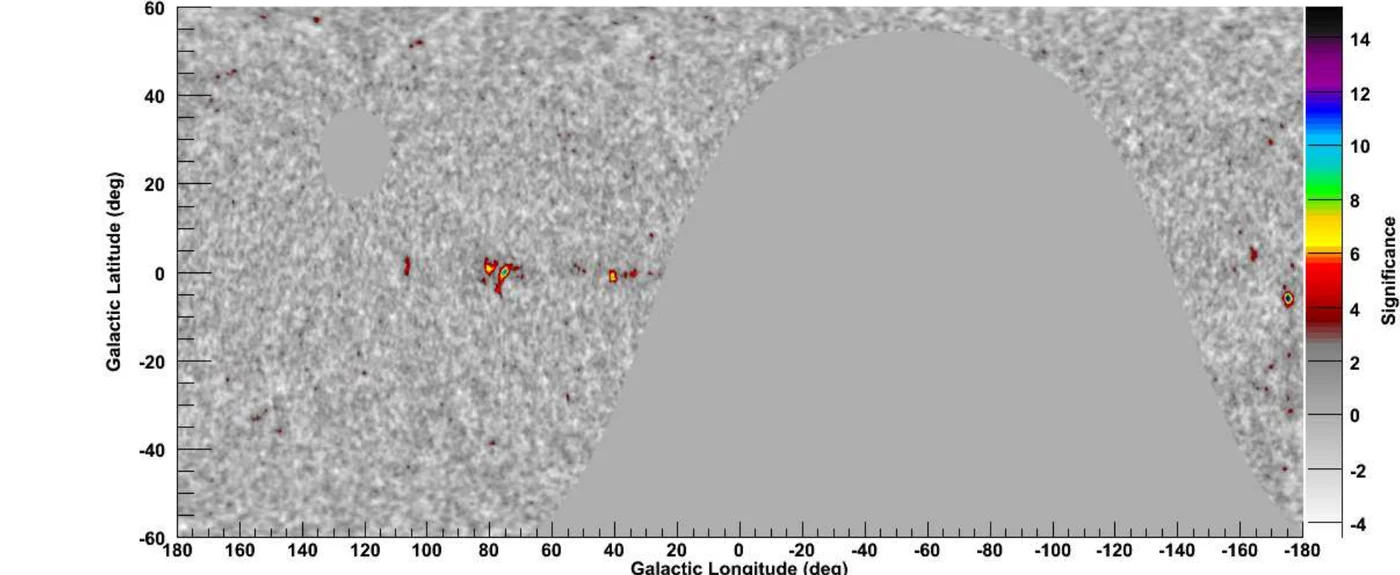
Four localized sources of TeV gamma-ray emission were discovered — three in the Cygnus region of the Galaxy (led by MGRO J2019+37, ~80% of the Crab flux at 20 TeV) and one toward the inner Galaxy (MGRO J1908+06). Beyond the point sources, a diffuse TeV emission was detected from Cygnus whose flux at ~12 TeV exceeds conventional cosmic-ray production-and-propagation models — pointing to hard-spectrum cosmic-ray sources, or new gamma-ray sources, hidden in the region. Additional candidates above 4σ were seen along the Galactic plane.
Read the Galactic-plane survey paper → · Read the diffuse-emission paper →
Why A₄ mattered
Milagro saw the entire overhead sky continuously, making it uniquely suited to large, low-surface-brightness sources. But cosmic-ray hadrons outnumber gamma rays by orders of magnitude. The A₄ variable exploits a real physical difference: hadronic showers are clumpy, scattering penetrating particles far from the core, while gamma-ray showers are smooth. Reading that clumpiness — and optimally weighting events by their likelihood of being gamma rays — delivered the sensitivity leap behind every discovery above.
The A₄ variable is defined as
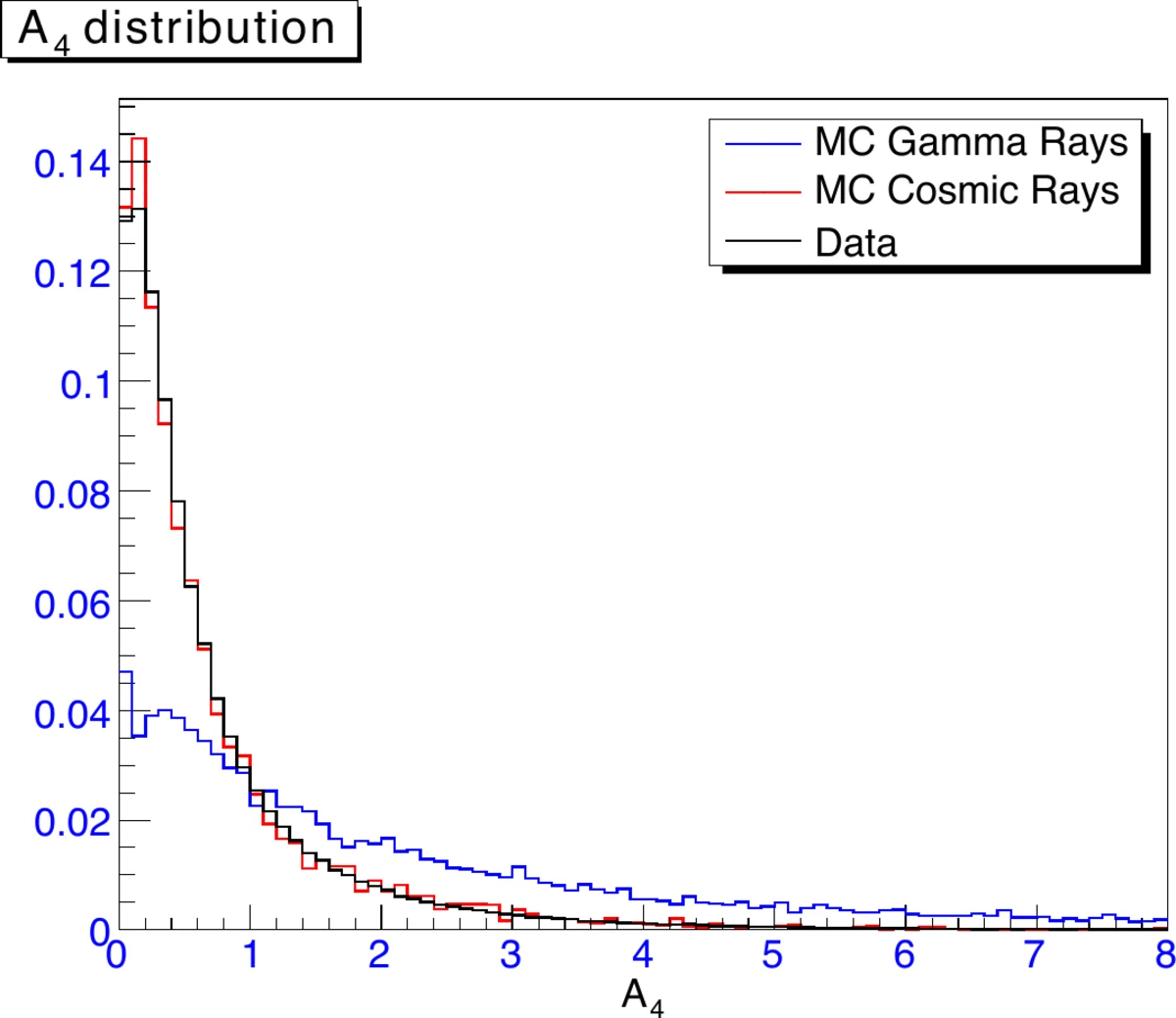
where ftop and fout are the fractions of air-shower and outrigger PMTs hit, Nfit the number of PMTs in the angle fit, and PEmaxB the largest signal in the muon layer — the clumpiness left by penetrating hadrons. As Abdo wrote it: the "A" stands for "Abdo," and the "4" for the number of parameters. A cut of A₄ ≥ 3.0 rejects 97.4% of cosmic-ray showers while keeping 27% of gamma rays — a decisive separation:
From the dissertation
The actual figures — the real data behind the interactive recreations elsewhere on this site.